The Compute Scarcity Trap: Why the 2026 Rollback Matters
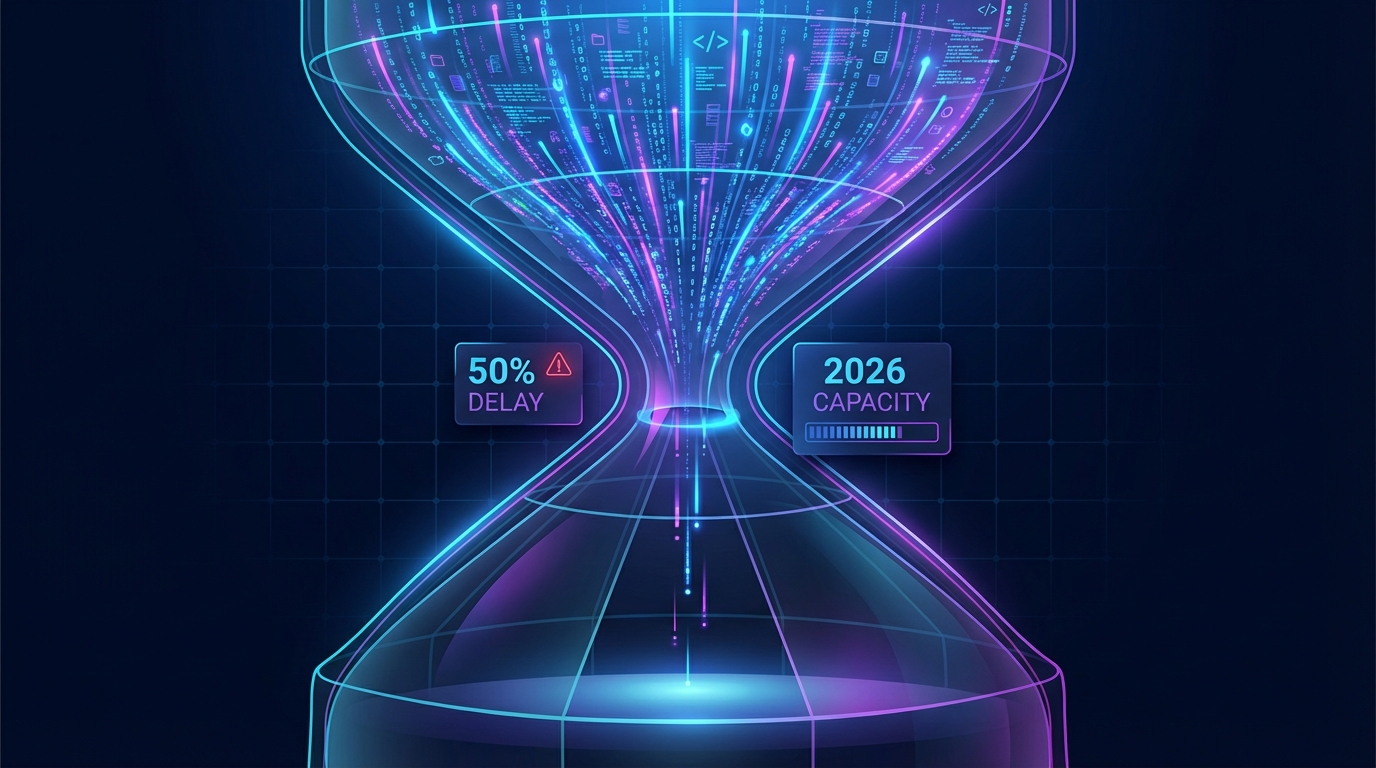
The artificial intelligence boom has triggered an unprecedented race for computational dominance, but the physical world is failing to keep pace. Tech leaders built their strategic roadmaps on the assumption of infinite, zero-friction cloud expansion. That illusion is now shattering, as nearly 50% of all US data center projects planned for 2026 are facing severe delays or outright cancellation according to TechSpot's recent market analysis. This sudden contraction transforms compute access from a basic commodity into a critical strategic vulnerability.
The paradox of the hyperscale era is that our relentless drive toward digital operational excellence has created a massive physical bottleneck. While software scales at a zero-marginal-cost pace, the concrete, steel, and high-voltage transformers required to power it operate on agonizingly slow industrial timelines. This physical drag on digital ambition forces a fundamental pivot in how organizations must forecast their technological capabilities. If your campaign or enterprise is banking on uninterrupted access to next-generation cloud infrastructure, you are actively miscalculating your operational risk.
The gap between anticipated demand and actual grid delivery is rapidly widening into a structural crisis. As outlined in McKinsey's analysis on expanding data center capacity to meet growing AI demand, the original expectation of bringing 12 to 16 gigawatts of new capacity online by 2026 is now critically endangered. This is not merely an IT procurement headache; it is a fundamental threat to ecosystem dominance.
To navigate this impending infrastructure drought, strategic decision-makers must recognize three unavoidable realities:
- Compute is the new real estate: Securing processing power is now a matter of corporate infrastructure sovereignty.
- Supply chains trump software: Physical hardware lead times of 52 to 86 weeks will dictate your AI deployment schedules.
- The grid is the ultimate gatekeeper: Local power constraints and community opposition will override even the most aggressive capital expenditure plans.
The Hardware Paradox: When Infinite Scaling Meets Finite Supply

The artificial intelligence revolution promised a zero-marginal-cost engine, but it is currently trapped in an analog traffic jam. Strategic decision-makers are discovering that while algorithmic models scale exponentially, the physical facilities required to house them remain bound by industrial-era limitations. This creates a dangerous strategic blind spot for organizations banking on uninterrupted computational growth to drive their future product roadmaps.
We are witnessing a massive disconnect between software ambition and hardware reality. According to TechSpot's reporting on the impending infrastructure crisis, nearly 50% of US data centers planned for 2026 face severe delays or outright cancellation. The primary culprit is not a lack of operational capital or market demand, but an acute, systemic shortage of critical electrical infrastructure necessary to power these hyperscale facilities.
Here lies the hidden vulnerability of the modern tech boom: dependency on legacy manufacturing pipelines is strangling next-generation innovation. Essential components like high-voltage transformers, switchgear, and commercial-scale batteries are currently experiencing agonizing lead times of 52 to 86 weeks. This heavy reliance on foreign manufacturing—particularly from Chinese suppliers—creates a severe geopolitical chokepoint that cannot be coded away or bypassed with agile software updates.
The economic friction severely compounds these physical supply chain failures. Rising construction costs, fueled by compounding tariffs, trade tensions, and persistent inflation, are forcing C-suite executives to drastically rethink their infrastructure timelines. As highlighted in Latitude Media's global infrastructure forecast, this bottleneck is not an isolated domestic issue but a global systemic failure, turning projected computing capacity into phantom assets.
For campaign leaders and strategic planners, this hardware paradox introduces severe operational realities that must be factored into immediate business strategy:
- Stranded Capital Risk: Billions of dollars are currently locked up in unfinished physical shells, waiting up to a year and a half for their electrical guts to arrive.
- Geopolitical Exposure: Sourcing critical power components from high-tension trade regions introduces unacceptable risk to domestic technology dominance.
- The First-Mover Penalty: Organizations that break ground without fully secured, end-to-end component pipelines will burn capital on idle construction sites, ceding agility to more pragmatic competitors.
The Supply Chain Short Circuit: Anatomy of a Megaproject Delay

The digital economy operates on milliseconds, but the physical infrastructure powering it is currently measured in years. While hyperscalers project exponential capacity growth, the reality on the ground is dictated by stubborn analog constraints. The core mechanism driving these unprecedented 2026 project cancellations is a fundamental misalignment between software ambition and hardware availability. As highlighted in TechRepublic's analysis of mega data center cancellations, the industry is slamming into a hard physical ceiling where capital alone can no longer accelerate timelines.
At the heart of this bottleneck is a legacy procurement model that has completely collapsed under the weight of AI-driven demand. Critical electrical infrastructure—specifically high-capacity transformers, switchgear, and utility-scale batteries—now require staggering lead times of 52 to 86 weeks. This delay is aggressively compounded by heavy reliance on foreign manufacturing ecosystems, particularly in China, creating a fragile dependency pipeline. You cannot compute without power, and you cannot route power without these highly specialized, heavily backordered components. For infrastructure strategists, this means the critical path is no longer determined by local zoning approvals, but by the manufacturing schedules of overseas heavy industry.
Even if developers successfully navigate the procurement gauntlet, they face the harsh reality of an antiquated macro-environment. The paradox of the modern data center is that its operational excellence relies on a fundamentally obsolete public utility grid. Deloitte's assessment of US infrastructure readiness for the AI economy reveals that local power grids simply cannot absorb the massive 12-16 gigawatt wattage spikes these combined facilities demand. This creates the "Grid Capacity Trap": organizations successfully secure billions in capital and physical hardware, only to find themselves legally barred from connecting to local substations.
This gridlock is completely rewriting the geographic map of technology investment and exposing the vulnerabilities of rural expansion. Rural areas in states like Georgia, Illinois, and Wisconsin were initially targeted for their cheap land, but they are now experiencing the highest concentration of project delays due to underdeveloped power transmission networks. Furthermore, McKinsey's research on the $7 trillion race to scale computing demonstrates how rising construction costs, fueled by tariffs and inflation, transform a 12-month delay into a fatal economic blow. When a project stalls at the structural phase, the accrued debt service rapidly destroys the asset's projected ROI.
To navigate this hostile development environment, campaign leaders must adopt defensive infrastructure strategies:
- De-Risk the Supply Chain: Shift from "just-in-time" purchasing to aggressive, multi-year forward-contracting for critical switchgear and transformers.
- Evaluate Grid Sovereignty: Prioritize sites with existing, underutilized power substations over expansive greenfield projects in rural zones.
- Model the Delay Premium: Factor a minimum 18-month hardware procurement buffer into all capital expenditure forecasts to avoid stranded capital.
The Hardware Chokehold: Anatomy of a Stalled Build

The collapse of the 2026 data center pipeline is not a failure of capital, but a failure of physical reality. Strategic initiatives are hitting a wall of unprecedented supply chain gridlock, driven by an acute shortage of critical electrical infrastructure. Components that were once standard procurement line items—specifically transformers, switchgear, and commercial-scale batteries—now command debilitating lead times of 52 to 86 weeks. As highlighted in Indiatimes's analysis of the widespread 2026 delays, this heavy reliance on foreign manufacturing ecosystems has transformed routine construction schedules into high-risk liabilities.
The Agility Trap: The very industry pushing for frictionless, zero-marginal-cost digital expansion is currently paralyzed by the heaviest, most analog industrial constraints imaginable. Developers racing to capture the AI boom ignored the macroeconomic realities of localized power grids, creating a fatal bottleneck where ambition outpaces infrastructure. The IEA's extensive study on surging energy demand from AI illustrates how this exponential power requirement is fundamentally incompatible with legacy grid architecture. You cannot build a sovereign digital fortress when the local utility cannot guarantee the baseline voltage required to cool it.
To understand the mechanics of this stall, executives must recognize the overlapping friction points degrading their development timelines:
- The Procurement Vacuum: Critical power routing hardware requires minimum 18-month lead times, forcing massive capital outlays for non-yielding assets long before ground is broken.
- Grid Interconnection Queues: Regional utility providers, overwhelmed by the 12-16 gigawatt expected capacity surge, are pushing interconnection approvals deep into the late 2020s.
- Geopolitical Vulnerability: Heightened tariffs and trade restrictions are choking the flow of raw materials and finished components from primary overseas suppliers.
To counter this operational paralysis, forward-thinking infrastructure campaigns are turning to automated leverage. Rather than accepting passive delays, industry leaders are deploying predictive analytics and AI-powered progress tracking to optimize the build schedules they can control. According to Constructiondigital's report on smart infrastructure companies, deploying these advanced management engines can reduce active construction delays by up to 50 percent. By treating the physical construction site as a data-rich ecosystem, executives can claw back months of lost time and protect their projected ROI.
Strategic Implication for Campaign Leaders: Survival in the next phase of infrastructure development requires treating hardware procurement as a core strategic pillar rather than a delegated operational task. Leaders must transition from localized tactical planning to absolute ecosystem dominance, auditing every tier of their hardware dependencies. If your 2026 capacity relies on a transformer currently sitting in an overseas manufacturing queue, that capacity effectively does not exist.
The Constriction Cascade: Navigating the Capacity Void

The immediate paralysis of 2026 data center pipelines is triggering a secondary crisis that extends far beyond missing switchgears and transformers. When hyperscalers fail to bring expected compute power online, the bottleneck forces a hyper-competitive race for existing legacy space. According to Datacenterwatch's analysis of blocked infrastructure, an astonishing $64 billion of data center projects have been stalled or blocked entirely, heavily driven by localized pushback. This massive capital freeze demonstrates that simply throwing money at supply chain deficits cannot overcome community-level operational friction.
Here lies the ultimate "Growth Paradox" for infrastructure developers. The aggressive pursuit of a zero-marginal-cost engine for artificial intelligence has triggered a profound defensive response from local municipalities and grid operators. By rapidly scaling physical footprints to secure compute sovereignty, technology firms are accumulating massive social and regulatory debt. The very ambition meant to secure market dominance is now the primary catalyst for legislative moratoriums and community backlash.
To survive this capacity void, organizations must pivot from centralized mega-builds to highly distributed, agile architectures. Rather than waiting on delayed 100-megawatt monolithic facilities, forward-thinking operators are exploring modular edge computing and retrofitting existing commercial spaces. PwC's report on technology and resilience underscores that future market leaders will prioritize multi-site resilience over sheer concentrated scale. This strategic shift dilutes the risk of any single community blocking a critical infrastructure node while bypassing the backlogged supply chains of massive electrical components.
Strategic Implication for Campaign Leaders: The era of guaranteed exponential compute growth is over, replaced by an environment defined by resource scarcity and community veto power. Decision-makers must immediately audit their 2026-2028 operational roadmaps assuming a permanent deficit in expected processing power. Campaigns that optimize their current digital infrastructure and secure decentralized computing alternatives today will wield decisive automated leverage over competitors who remain trapped in the queue for stalled mega-centers.
The Blueprint for Computational Sovereignty

The sweeping delays of 2026 data center projects do not represent a temporary supply chain glitch; they signal a permanent structural realignment of the digital economy. Campaign leaders and C-suite executives can no longer rely on the assumption of infinite, cheap cloud expansion. As highlighted in an Academic Institution's comprehensive analysis on the future of data centers, navigating this prolonged bottleneck requires a fundamental shift in how organizations forecast and deploy their infrastructure. The organizations that survive this squeeze will treat processing power as a finite, premium asset rather than a ubiquitous utility.
However, leaders must beware the "Hoarding Trap" when securing future capacity. Reactively over-provisioning server space out of panic creates massive financial overhead, transforming operational excellence into bloated infrastructure debt that drains capital without yielding strategic leverage. To achieve true computational sovereignty, decision-makers must implement a leaner, more resilient ecosystem:
- Audit and Prune Workloads: Eliminate idle compute processes and consolidate redundant data streams to maximize existing server capacity.
- Deploy Edge Architectures: Pivot investments toward decentralized, smaller-scale edge computing networks that bypass the regulatory and supply chain gridlocks of mega-centers.
- Prioritize Algorithmic Efficiency: Invest heavily in software optimization that achieves superior analytical outcomes using a fraction of the raw processing power.
The path forward demands a rapid transition from brute-force scaling to precision engineering. Campaigns that master this optimization will forge a zero-marginal-cost engine, securing undisputed ecosystem dominance while competitors remain paralyzed by hardware shortages and gridlocked construction.
TL;DR — Key Insights
- Nearly 50% of US data centers planned for 2026 face delays or cancellations due to a compute scarcity trap.
- Critical electrical infrastructure components have lead times of 52-86 weeks, creating a significant supply chain bottleneck.
- Local power grid limitations and community opposition are overriding capital expenditure plans, impacting project viability.
- Organizations must shift from assuming infinite cloud expansion to strategic forecasting of finite, premium compute assets.
Frequently Asked Questions
Why are so many data center projects for 2026 being cancelled or delayed?
Nearly 50% of US data center projects planned for 2026 are facing delays or cancellations. This is primarily due to a "compute scarcity trap," driven by a shortage of critical electrical infrastructure components and limitations in local power grids.
What are the main reasons for the data center delays and cancellations?
The primary causes are long lead times (52-86 weeks) for essential electrical components like transformers and switchgear, coupled with the inability of local power grids to support the massive energy demands of new hyperscale facilities. Geopolitical factors and rising construction costs also contribute.
How does the AI boom contribute to this data center issue?
The unprecedented demand from the AI boom has accelerated the need for computational power, overwhelming the physical infrastructure capabilities. While software scales rapidly, the physical construction and power delivery for data centers operate on much slower, industrial timelines.
What are the key implications for organizations planning for future compute needs?
Organizations can no longer assume infinite and cheap cloud expansion. They must now treat compute as a finite, premium asset, strategically forecasting needs, optimizing existing infrastructure, and exploring decentralized edge computing solutions to navigate supply chain and grid limitations.